
In early 2001, a devastating 7.6 magnitude earthquake struck western Gujarat on 26th January – the Republic Day of India. This was one of the worst natural disasters in country’s history which left more than 20,000 people dead; about 1,67,000 injured and over 6,00,000 people homeless. The epicentre was close to the city of Bhuj in Kachchh District of Gujarat, wherein 95% of the buildings were completely destroyed or rendered uninhabitable. In one of the most heart-wrenching incidents, 185 school children and 20 teachers were killed while they were passing through a lane as part of the Republic Day parade at Anjar, a Sub-District of Kachchh.
Offers of assistance poured in from all around the world, including from the neighbouring country of Pakistan. A week after the earthquake, General Parvez Musharraf, who had seized power in a military coup in October 1999 and had been ruling Pakistan as its Chief Executive, contacted Prime Minister Atal Bihari Vajpayee telephonically and offered further aid to the earthquake survivors.
This helped break the ice and, two years after the Kargil conflict, the two countries were once again on speaking terms. Vajpayee government extended an offer of talks to General Musharraf to resolve the long-standing bilateral concerns, including the issue of Kashmir.
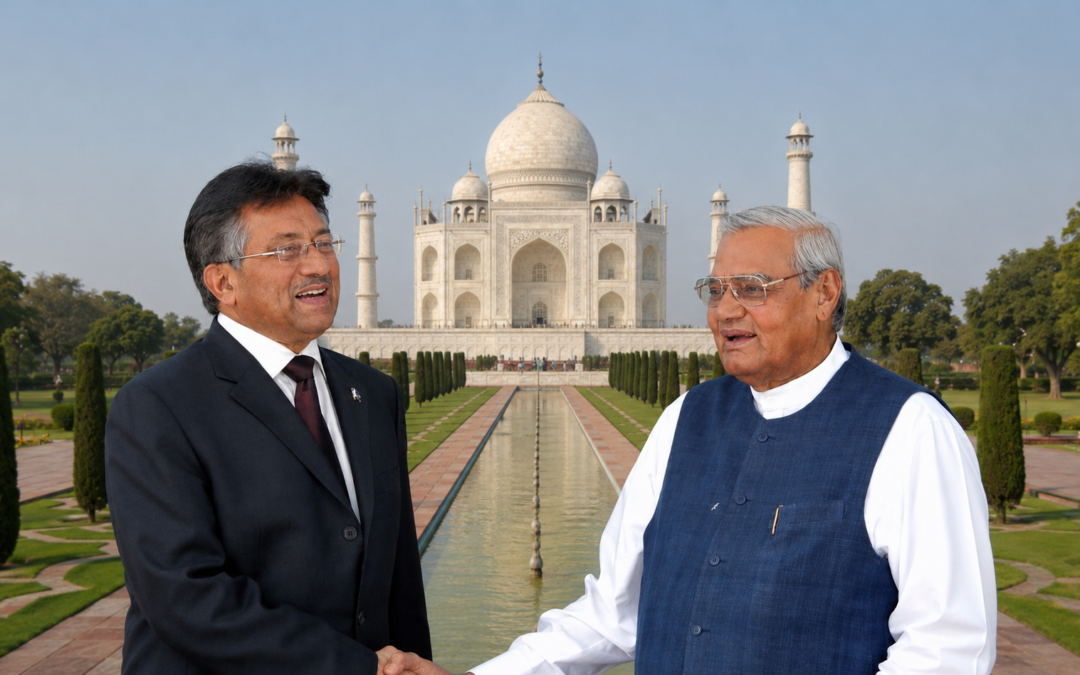
By mid-June, having formally assumed the office of President of Pakistan, Parvez Musharraf visited India to attend Agra Summit during July 14-16, 2001. During his trip Musharraf visited his ancestral home ‘Nehar Wali Haveli’ at Daryaganj (Delhi). He also visited Taj Mahal at Agra, the venue of the Summit. The atmosphere was full of hopes and expectations for the peace lovers of both the countries. In Musharraf’s words (as recorded in his memoir ‘The Line of Fire’) :
“I generally perceived the mood in India to be upbeat. Wherever Sehba and I went, there was a strong show of warmth and affection, be it among the hotel employees we encountered, the officials we met, or the ordinary Indians and the several families now living in my ancestral home, Nehar Wali Haveli. There was a discernible air of expectancy.”
Many speculated that the two premiers might agree to convert the existing Line of Control (LoC) into an international border thereby largely resolving the Kashmir issue. However, the reality on the ground was very different from the impression doing the rounds, thanks to the media which had taken centre stage. While Musharraf insisted that Kashmir was the ‘core issue’, the Minister of Information & Broadcasting in India viewed it as just one among the several concerns, placing the issue of ‘cross-border terrorism’ at the forefront.
Ultimately, despite apparent sincere efforts on the part of both the leaders, things did not turn out the way it was expected. The talks ended abruptly and after a lot of high-voltage drama, Musharraf returned to his country empty handed – without even a joint statement been issued by the two Premiers. Musharraf noted in his memoir :
“I met Prime Minister Vajpayee at about eleven o’clock that night in an extremely somber mood. I told him bluntly that there seemed to be someone above the two of us who had the power to overrule us. I also said that today both of us had been humiliated. He just sat there, speechless. I left abruptly, after thanking him in a brisk manner. There is the man and there is the moment. When man and moment meet history is made. Vajpayee failed to grasp the moment and lost his moment in history.”
Though it was General Musharraf who orchestrated the Kargil intrusion, I think majority of the pacifists in India still trusted his sincerity when he spoke of ‘peace’ and of finding a solution ‘outside the box’ for Kashmir issue. Maybe it had to do with the fact that Musharraf was born in India. Moreover, his straightforwardness, clarity of mind and his remarkable ability to communicate his ideas with precision and candor really impressed everyone. For me personally, given a choice between a politician and an army-man, I would in all probability trust the army-man rather than the politician. Even otherwise, a wise enemy is invariably less dangerous than an unwise friend.
Prominent Journalist Karan Thapar recounted an amusing incident concerning General Musharraf in his book ‘Sunday Sentiments’. It was when he interviewed the General at Islamabad. His first objective was to get Musharraf “to accept he is a military dictator and that his claim to be restoring democracy is codswallop”. He wasn’t scared but a bit apprehensive that things might not go well. Nevertheless he did his job. In Thapar’s words – “Of course, he defended himself, always fluently often ably and even nodded in agreement with some of the comments I made. By taking my critique on the chin and showing no anger, he cleverly defused it.”
During the commercial break, Thapar complimented the General on his tie. When the interview ended, the General undone his tie and gifted it to Thapar as his ‘gesture of conciliation’ to him. Thanking him, Thapar then looked at the gold tie-pin and chain, added with a laugh, “I should have admired the gold chain. Maybe you would have given that to me as well. The General roared. “हाँ.” He said, “और अगर आपको जूती पसंद आई होती तो वो भी मिल जाती!” (Yes, and if you had liked the shoes, you would have gotten those too).
The spontaneous gesture of gifting his tie had brought about a sea change in the mood which was full of bonhomie now. In Thapar’s words – “It wasn’t only I who felt it. My colleagues, who had come with me from India, were equally aware of the altered atmosphere and the fact that General Musharraf deserved credit for it. Their verdict said it all : “बंदा सही है. बुरा नहीं. दिल का साफ़ है.” (He’s a good guy. Not bad at all. He has a clean heart).
As I have already mentioned a couple of times before, my present work is an account of my inward journey to understand my own self better and also to understand exactly when and how my beliefs, assumptions and perceptions began to shift and what prompted those changes. Here, in the process of writing this chapter, I witnessed a subtle change unfolding within me.
During Musharraf’s visit, India was imbued with a spirit of bonhomie and optimism, signaling the dawn of a new era in Indo-Pak relations. Although there were a few who I heard saying, ‘If he (Vajpayee) keeps this up, he will end up giving Kashmir to them.’ But, overall a feeling of warmth and goodwill surrounded everyone. I too was no more acting like a typical right-wing ideologue. Like many others, I was also looking forward to the two heads of the States arriving at an amicable settlement of the long standing Kashmir issue giving peace a chance.
What was bringing about this change? Did it have anything to do with my admiration for Musharraf for his straightforward manner, clarity of mind and eloquence? No, this alone could not have been the reason. The actual reason was my high regard for Vajpayee. To this day, I believe he was the only Prime Minister who sincerely and wholeheartedly sought to mend relations between India and Pakistan. Despite having been backstabbed once, Vajpayee chose to try again — a decision that required a lot of courage and conviction, both of which he had in abundance.