
The day Vajpayee Government lost the floor test by a single vote in the Parliament on April 17, 1999 remains vivid in my memory. It was really agonizing to see how the decision to participate in the crucial voting was left to the Congress MP Giridhar Gamang’s conscience, who had already taken over as the Chief Minister of Odisha thereby losing the moral right to vote as a Member of Parliament in the apex legislative body of India.
With whatever little knowledge I had of the whole issue, it felt as if something unethical had taken place on the floor of the House that day. Even though Gamang had not yet resigned from the Lok Sabha, once he assumed the Chief Minister’s post in a State, it seemed ethically inappropriate on his part to have participated in such a crucial voting in the Parliament. However, following the party whip, Gamang did vote and the Vajpayee Government lost the confidence motion by one vote.
In hindsight, however, the whole episode was a blessing in disguise for the Vajpayee Government which was already finding it difficult to function with some of its belligerent coalition partners constantly rocking the boat. The manner in which the government fell, portrayed Vajpayee as a ‘victim’ in the hands of the Opposition; and considering that Indian are an emotional lot, this was going to benefit the outgoing Vajpayee government only. And so it happened. BJP led NDA returned to power in the next general elections, and this time, with absolute majority.
* * * * * * * * * *
In between however a major event took place – the Kargil conflict. In May 1999, some shepherds spotted presence of ‘foreign’ militants occupying certain unmanned border posts along the Line of Control (LoC) in Kargil District of Jammu & Kashmir. The Indian army swung into action and launched operation Vijay on May 26 to push the intruders back. About two and a half month long Kargil conflict led to loss of precious lives on both sides with Indian side losing more than 500 of its bravehearts during the entire operation.
To this day, two names remain deeply engraved in my memory – one is Captain Vikram Batra (military code name “Shershah”), Param Vir Chakra (posthumous), for his legendary ‘ये दिल मांगे मोर’ (a famous Pepsi cola jingle those days) during an interview with the NDTV correspondent Ms. Barkha Dutt, days before his supreme sacrifice for the country. The other name is Captain Vijayant Thapar, Vir Chakra (posthumous), for his last letter to his family where he had written “By the time you get this letter I’ll be observing you all from the sky enjoying the hospitality of the Apsaras”. We were especially proud as Capt. Thapar hailed from our city Noida. A prominent arterial road in the city has been named after him – Captain Vijayant Thapar Marg.
I also remember a military spokesperson, who frequently appeared on TV those days, visiting our office once. I’m not able to recollect his name, but he was a very handsome Sikh gentleman. He had come to see my boss, whose younger brother was in Army and posted somewhere in J&K around that time. Though I recognized him immediately, I wasn’t entirely sure, as I was too surprised to see him in our office. He sensed my confusion and smilingly dispelled my doubt by saying – “हाँ, मैं वहीँ हूँ जो टीवी में आता हूँ” (Yes, I’m the same person who appears on TV).
During his meeting with my boss, he handed him a copy of the book “Kargil – the Inside Story (A Soldier’s Diary)” by Harinder Baweja. I borrowed the book from my boss later. It was so interesting that I finished reading it in no time. When I returned the book, my boss asked me how I liked it. I said it was very informative. However, I found the mention of an incidence where a slain enemy soldier’s head was severed and pinned to a tree-trunk outside the Brigade Headquarters, a bit ‘uncomfortable’. I said, the author could have avoided mentioning this gruesome incident especially in the light of the narratives being circulated that our army, showing their most human face, buried the slain enemy soldiers with proper rituals when Pakistan refused to recognize them as their soldiers and take their bodies back.
One interesting incident I recall from the book is when a message underwent a ‘telephone game’ effect and reached the then Defence Minister George Fernandes with an entirely different version. It happened that when our army was still at a considerable distance away from their target ‘Tiger Hill’, a message was conveyed to the Brigade HQs that ‘they are short of the top’. However, somewhere along the way to Delhi, the message got distorted and become – “they are on Tiger Top”. The Defence Minister, who was addressing a public rally in Punjab, proudly declared the capturing of Tiger Hill, while it was still in the hands of the enemy. The ‘declaration’ put extra pressure on the army to be “more frantic and frequent” in their efforts to re-capture the Hill. Finally, after three days of fierce fighting against all odds, Tiger Hill was finally re-occupied by Indian Army ensuring “no embarrassment for the Defence Minister”.
* * * * * * * * * *
Back to Vajpayee, I still believe he was the one Prime Minister who, from the bottom of his heart, tried to normalize the ties with Pakistan to avoid any future conflicts. During his short stint of 13 months as Prime Minister, he undertook a bus journey to Lahore inaugurating Delhi-Lahore bus service called “सदा-ए-सरहद” in February 1999 as a confidence-building measure between the two countries. Vajpayee was warmly received by the Pakistani Prime Minister Nawaz Sharif. The two leaders signed the historic Lahore Declaration, pledging peaceful resolution to conflicts, including the Kashmir issue.
As a part of his ‘bus diplomacy’ Vajpayee also visited Minar-e-Pakistan, which was built to commemorate the Lahore Resolution (for creation of independent states for Muslim majority areas). Pouring his heart out in the visitor’s book, Vajpayee scribed – “A stable, secure and prosperous Pakistan is in India’s interest. Let no one in Pakistan be in doubt. India sincerely wishes Pakistan well.”
The purity of Vajpayee’s intentions shone through in his poetry :
भारत पाकिस्तान पड़ोसी, साथ साथ रहना है… प्यार करें या वार करें, दोनों को ही सहना है
तीन बार लड़ चुके लड़ाई, कितना महँगा सौदा… रूसी बम हो या अमरीकी, ख़ून एक बहना है
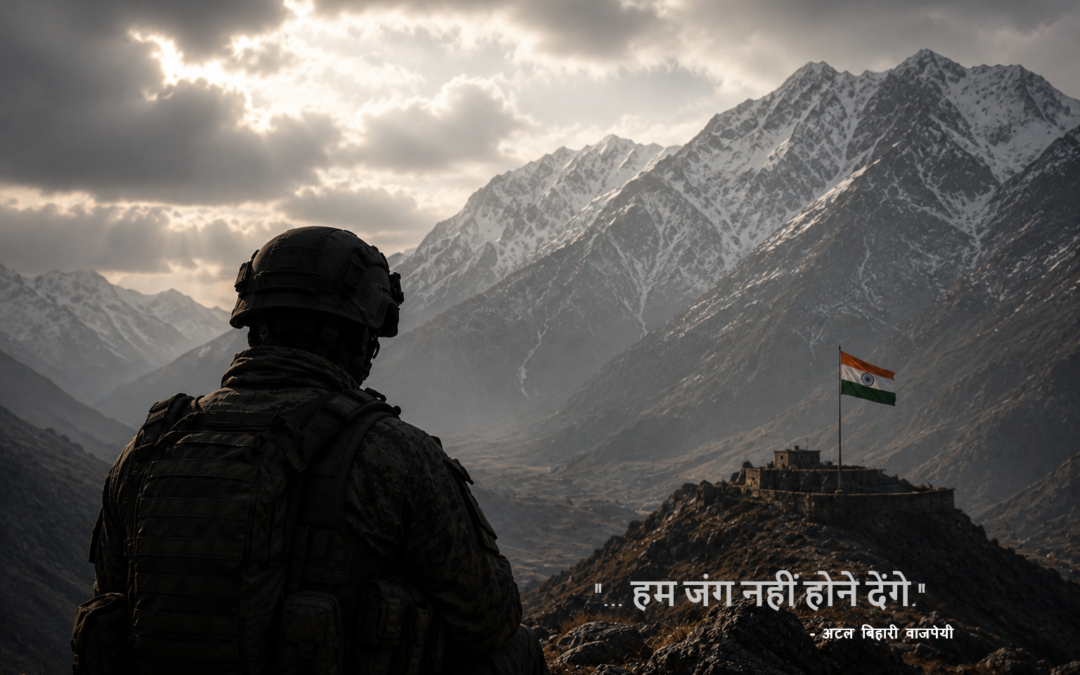
जो हम पर गुज़री, बच्चों के संग न होने देंगे… जंग नहीं होने देंगे, हम जंग नहीं होने देंगे
However, the bonhomie between India and Pakistan did not last long. Apparently, while the two Prime Ministers were busy in exchanging pleasantries, Pakistani army was preparing for a covert operation to send its troops into Kargil, which ultimately led to about three-month long skirmish between the two countries. With all its good intentions, Vajpayee’s ‘bus diplomacy’ failed to travel down the road to peace and harmony.
– Ranjeet Chowdhury